
Traditional National Qualification Frameworks (NQFs) often utilize complex, multi-tiered structures ranging from 8 to 10 levels. While these work well for tracking academic tenure, they introduce unnecessary friction for international recruiters, trade bodies, and industry employers.
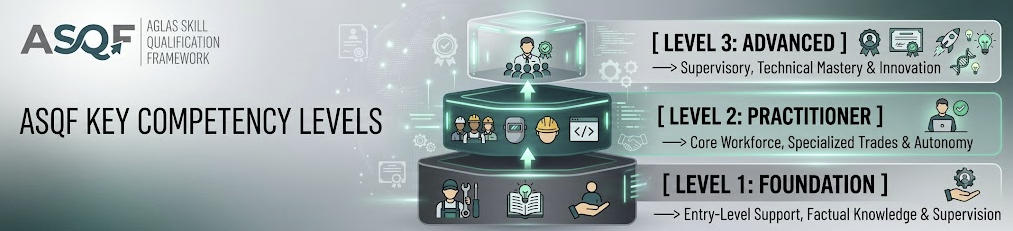
The AGLAS Skill Qualification Framework (ASQF) addresses this by compressing professional competencies into a highly functional, 3-Level Matrix. This structure focuses strictly on operational autonomy, technical complexity, and measurable learning outcomes.
Detailed Level Descriptors
Each level within the ASQF is governed by distinct structural indicators that define exactly what a certified individual knows, can do, and can manage.
AGLAS Skill Qualification Framework (ASQF) Levels
| Characteristic | Level 1: Foundation | Level 2: Practitioner | Level 3: Advanced |
| Operational Focus | Entry-Level Support & Basic Competency. | Skilled Roles & Independent Execution. | Technical Specialization & Supervisory Leadership. |
| Knowledge Profile | Acquisition of essential general, factual, and foundational industry knowledge. | Factual and theoretical understanding of key industry concepts, standard operating procedures (SOPs), and underlying technical principles within a specific field. | Broad, specialized theoretical understanding and advanced applied principles of an occupational domain. Includes a comprehensive grasp of industry-level optimization and system design. |
| Skill Capabilities | Execution of fundamental cognitive and practical tasks using basic tools. Certified individuals can solve predictable, repetitive problems within highly structured environments. | Advanced cognitive and practical skills required to select and apply standard methods, materials, and tools. Certified individuals can diagnose and resolve routine, non-complex technical issues. | Master-level cognitive and practical skills. Advanced certified individuals excel at solving complex, non-routine, and unpredictable problems, introducing innovations, and evaluating system-wide performance. |
| Autonomy & Responsibility | Works under direct, continuous supervision. The individual holds responsibility for the completion of their own assigned tasks but operates within strictly defined boundaries. | Works with a healthy degree of independence. Practitioners display self-management within the parameters of familiar tasks and can adapt their behavior to changing everyday circumstances. | Complete self-management and operational autonomy. Holds direct responsibility for the management of technical work, team leadership, project supervision, and the strategic professional development of peers. |
| Global Pathways | General assistants, trade helpers, initial apprenticeships, and entry-level support staff across international hospitality, logistics, and manufacturing sectors. | Specialized core workforce, certified technicians, solar PV installers, industrial electricians, and skilled digital support specialists. | Plant supervisors, senior technical experts, renewable energy designers, project managers, and lead trainers. |
Cross-Framework Interoperability Matrix
To ensure cross-border talent mobility, the ASQF levels are systematically mapped to major regional frameworks, providing immediate clarity to international employers.
| ASQF Level | Equivalent EQF Level (Europe) | Typical Gulf Framework Level | Primary Assessment Method |
| Level 1: Foundation | EQF Level 2 / Level 3 | Foundational Certificate | Practical demonstration, baseline oral questioning, and safety compliance audits. |
| Level 2: Practitioner | EQF Level 4 | National Diploma / Skilled Technician | Competency logbook review, independent task execution, and routine troubleshooting simulation. |
| Level 3: Advanced | EQF Level 5 / Level 6 | Advanced/Higher Diploma | Capstone project defense, system design evaluation, and peer leadership portfolio audit. |
The Mobility Principle: By maintaining a streamlined 3-level approach, ASQF ensures that an employer in Munich, Riyadh, or Singapore can instantly assess a candidate’s operational tier without navigating country-specific academic terminology.