Across major labor-exporting and receiving regions, millions of highly capable workers possess the precise skills industries need, yet their qualifications remain locked inside localized national systems. Traditional National Qualification Frameworks (NQFs) are often fragmented and lack international interoperability, creating massive systemic friction during cross-border recruitment.
The AGLAS Skill Qualification Framework (ASQF) was conceptualized to solve this specific global crisis. It serves as a transparent, portable, and outcome-based mechanism that translates local competence directly into a universally understood global language.
Our Foundational Metric: Workforce mobility should be defined by verified, practical capability—not by geographical borders or rigid, non-transferable regional credentials.
Core Pillars of the Framework
The ASQF functions through four interconnected pillars that differentiate it from rigid academic structures:
-
Outcome-Based Validation: We evaluate what a worker can actually execute and independent problem-solving capacities rather than tracking hours spent in a classroom.
-
Dynamic Framework Mapping: ASQF operates as a bridge, mapped continuously against major regional standards like the European Qualifications Framework (EQF) and emerging Gulf nation standards.
-
Recognition of Prior Learning (RPL): A significant portion of the global workforce develops mastery through informal apprenticeships and on-the-job execution. ASQF provides a mathematically structured pathway to audit, verify, and formally certify this invisible talent pool.
-
Sectoral Versatility: Built with a modular structure, the framework can scale rapidly across technically intensive fields including Renewable Energy, Green Technology, and Digital Services.
System Architecture: A Greener, Leaner Framework
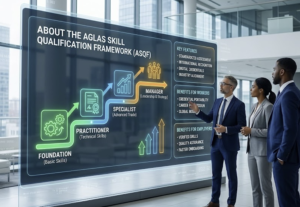
Instead of utilizing traditional 8-to-10 level academic hierarchies that confuse international recruiters, ASQF condenses competency into a highly functional 3-Level Matrix. This structure categorizes workforce capabilities straight into operational tracks: Foundation (Level 1), Practitioner (Level 2), and Advanced (Level 3).
Furthermore, ASQF places a distinct emphasis on future-proofing labor. We embed sustainable competencies, carbon literacy, and operational ethics directly into our core curriculum registries, supporting the global transition toward Green TVET (Technical and Vocational Education and Training).
Meet the Author & Innovator
The AGLAS Skill Qualification Framework was designed and conceptualized by Khan Mohammad Mahmud Hasan, a distinguished TVET expert, employability master trainer, and professional researcher.
With deep experience designing national qualification structures, competency logbooks, and leading workforce development initiatives with international bodies like the International Labour Organization (ILO) and major technical development programs, he developed the ASQF White Paper to finally establish an equitable, frictionless pathway for global talent mobility.